
Yorkshire Stone Roofs in Sheffield: Repair, Re-Laying and What Stone Roofing Costs
Traditional roofing guide | Sheffield & South Yorkshire
Quick answer
A Yorkshire stone roof is not laid like a tiled one. The stones are randomly sized and set in diminishing courses — big at the eaves, smaller towards the ridge. That single fact drives the cost, the labour and why so many re-lays go wrong. Expect stone re-laying in Sheffield from around £180 per square metre.
Here is the thing most guides to stone roofing miss entirely. Yorkshire stone slates are not slate.
Real slate is metamorphic rock. Yorkshire stone slates are sedimentary — sandstone, split along its bedding. Historic England’s technical advice note on the subject is explicit that it deals with stone slates from limestone and sandstone rather than real slates, which are from metamorphic rock, and it places the South Pennines and Yorkshire sources in the Carboniferous Coal Measures and Millstone Grit.
That is the geology directly under Sheffield. The stone on the roofs in Stannington, Crookes, Stocksbridge, Penistone and the Peak-fringe villages came out of the ground within a few miles of where it was laid. It behaves differently to slate, it weighs considerably more, and it needs a different set of skills on the roof.
Diminishing courses: the detail that decides the whole job
Walk past an old stone roof and look at the courses. The stones at the bottom are large and deep; each course going up is a little shorter than the one below it.
This is not decoration. Historic England describes the principle directly: stone slates are randomly sized and laid in diminishing courses, because the range of sizes reflected whatever the quarry could yield and using all of it maximised the usable rock.
The practical consequence is that a stone roof has to be sorted before it can be laid. Every stone coming off the roof is measured and stacked by length, then the roofer works out how many courses each size will make and how the batten gauge changes as the courses shorten up the slope.
Skip that and you get the tell-tale sign of a bad re-lay: a roof with courses of roughly equal depth all the way up. It sheds water less well, it looks wrong from the street, and on a building in a conservation area it can attract the attention of the council.
Our view: the most valuable thing on a Sheffield stone roof is the stone that is already on it. Reclaimed local stone that has weathered on the same building for two centuries cannot be bought back once it has gone in a skip. Any quote for a stone re-lay should say, in writing, what percentage of the existing stone is expected to be re-used and who owns the surplus.
Repair, re-lay or replace: three different jobs
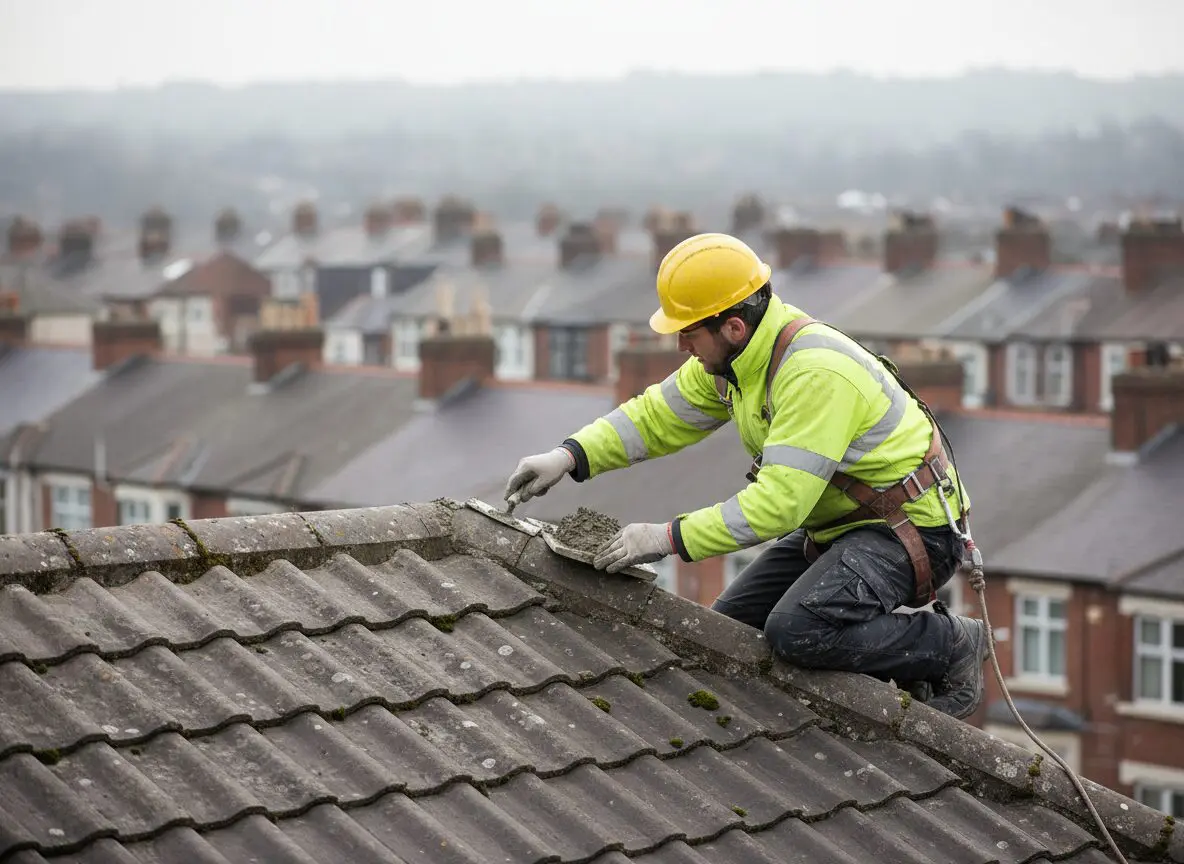
Repair means dealing with a defined area — slipped stones, a failed valley, cracked bedding at the ridge, or perished torching. On a sound roof this is routine work and the right answer far more often than people expect.
Re-laying (sometimes called stripping and re-slating) means taking the whole slope off, sorting the stone, renewing the battens and underlay, replacing the stones that have delaminated, and setting the whole lot back in diminishing courses. The structure and most of the material stay. This is the job that returns a tired stone roof to another lifetime of service.
Replacement means new material. It is the least common outcome on a genuine stone roof and the one we recommend least often, because new stone is expensive, the colour will not match for years, and the weight calculation has to be redone.
Deciding between them is an inspection job, not a phone-call job. The condition that matters most is delamination — stone splitting apart along its bedding planes after decades of frost. A roof where most stones are sound is a re-lay. A roof where a large proportion are shelling apart is a much harder conversation.
What Yorkshire stone roofing costs in Sheffield
Stone is the most expensive common roof covering in South Yorkshire, and there is no honest way to present it otherwise. These are indicative from-figures based on our own recent work, not quotations.
| Work | Typical range | Notes |
|---|---|---|
| Localised stone repair / re-fixing slipped stones | from £350 | Access and height dominate on small jobs |
| Stone valley or ridge re-bedding | from £600 | Lead and lime mortar work included |
| Strip, sort and re-lay existing stone | from £180 per m² | Assumes most stone is re-usable |
| Re-lay with 25–40% replacement stone | £230 – £320 per m² | Reclaimed stone availability drives this |
| Structural strengthening found during strip-off | from £1,200 | Usually purlin or rafter work |
| Scaffold for a typical stone re-lay | £900 – £2,500 | Longer hire than a tiled roof — the work is slower |
From-prices based on our own recent Sheffield and Peak-fringe work. Not a quote — we inspect before we price.
Two things push a stone job above a tiled equivalent. The first is labour: sorting and gauging is slow, skilled work and there is no way to speed it up. The second is scaffold duration, because the roof is exposed for longer. If you are comparing this against other coverings, our comparison of roofing materials for Sheffield homes puts the options side by side.
Weight, structure and building control
This is where stone roofs differ most sharply from everything else, and where the regulations bite.
A stone roof is heavy, and the roof structure beneath it was built for that weight. Take the stone off and put something lighter on and the structure is under-loaded; take a tiled roof and put stone on it and the structure is over-loaded. Both are problems.
The Planning Portal is direct about the consequence. Where an existing covering is replaced with a different material, approval under the Building Regulations is likely to be needed to ensure structural stability where the replacement is significantly heavier or lighter, and it advises checking with a structural engineer or surveyor before work begins. Separately, approval is required where a new covering increases the weight of the roof covering by 15 per cent or more.
There is a subtler version of the same trap that Historic England flags: the risk of unbalancing the loading where stone is used on one pitch and lighter material on the opposite pitch. Half-and-half roofs happen more often than you would think, usually because one slope was done cheaply years ago.
Strip-off is also the only honest opportunity to inspect the timber. On a roof that has carried stone for two hundred years, we would rather find a tired purlin with the covering already off than a year later. If you have seen a dip in the roof line, our guide to what a roof inspection covers explains what we look for.
We inspect stone roofs properly — on the roof and in the loft — and we will tell you honestly whether it is a repair or a re-lay. Call 07852 940350 or email ajrroofing17@gmail.com.
Conservation areas, listed buildings and Article 4
Sheffield has a large number of conservation areas, and stone roofs cluster inside them. That does not mean you cannot touch the roof — it means the material and the detailing matter to the council as well as to you.
As a rule of thumb: genuine like-for-like repair on an unlisted house in an ordinary conservation area is usually not something you need consent for. Changing the material is a different matter, and so is any external work on a listed building, where listed building consent applies regardless of how minor it looks. Some conservation areas also carry an Article 4 direction, which removes permitted development rights that would otherwise apply.
Because it varies street by street, the sensible move is a five-minute check with Sheffield City Council’s planning team before you commit to a specification. It costs nothing and it is considerably cheaper than being asked to take a roof off again.
Keeping the roof watertight in the meantime is its own job. Failed underlay under stone is common on roofs that have never been stripped, and we cover the warning signs in our guide to spotting failing roof underlay. For the areas we cover and the housing stock in each, see our Sheffield roofing page.
Frequently Asked Questions
How long does a Yorkshire stone roof last?
Longer than almost anything else. Historic England’s guidance notes that a well-maintained stone slate roof can last at least a century and possibly a great deal longer. In practice the stone usually outlives the battens, the underlay and the fixings several times over, which is why re-laying the same stone is such a common and sensible job.
Can you re-lay a stone roof using the original stone?
Yes, and in most cases you should. On a typical Sheffield stone roof the majority of stones come off sound and go back on. The stone is measured and sorted by size first, then re-laid in diminishing courses onto new battens and underlay. Only the delaminated stones need replacing.
Is stone roofing more expensive than slate or tile?
Yes. Both the material and the labour cost more, and the scaffold is up for longer because the work is slower. As a broad guide, re-laying existing stone starts from around £180 per square metre in our area. Set against a lifespan measured in centuries, the cost per year is a different picture entirely.
Do I need planning permission to repair a stone roof in Sheffield?
Like-for-like repair on an unlisted house is generally not something that needs planning permission. Changing the covering material, working on a listed building, or working in a conservation area with an Article 4 direction can all change that. Check with Sheffield City Council before finalising the specification.
Why are the stones bigger at the bottom of the roof?
Because stone slates are randomly sized and laid in diminishing courses. Larger, heavier stones go at the eaves where the water volume is greatest and the structure is strongest, with progressively shorter stones running up towards the ridge. It is the defining characteristic of a properly laid stone roof.
What is delamination and can it be repaired?
Delamination is the stone splitting apart along its natural bedding planes, usually after long exposure to frost. An individual delaminated stone cannot be repaired — it is replaced. What matters is the proportion of the roof affected, which is exactly what an inspection is for.
Call AJR Roofing on 07852 940350 for a free, no-obligation quote. We inspect before we price — no surprises.
Reviewed and signed off by AJR Roofing— working roofers covering Sheffield, Rotherham, Barnsley, Doncaster, Chesterfield and the surrounding area. Prices are indicative from-figures based on our own recent work and are not a quotation. Consent requirements vary by property — always check with your local planning authority.
Published 3 November 2026 · Last updated 3 November 2026