
Sagging Roof in Sheffield: What Failed Rafters and Purlins Cost to Put Right
Structural roofing guide | Sheffield & South Yorkshire
Quick answer
Sagging roof repair cost in Sheffield usually turns on one question: is the dip in the covering, or in the timber underneath? Re-bedding a settled ridge line starts from around £450. Sistering or replacing a failed purlin, with propping and scaffold, typically runs from £1,800 to £4,500 depending on span and access.
Almost every sagging roof we get called to in Sheffield has the same shape of problem, and it is rarely the tiles. It is the purlin.
A purlin is a long timber running horizontally across the roof, normally about half way up the rafters. The Planning Portal describes them plainly: they act like beams to reduce the unsupported span of the rafters, with struts underneath carrying that load down onto a load-bearing wall. When a purlin deflects, every rafter it supports drops with it, and you get the long, smooth dip in the roof line that people photograph from the pavement and send to us.
That distinction — covering versus structure — decides everything about the cost. So this guide starts there.
What is actually sagging: a five-minute diagnosis from the ground
Stand at the far side of the road and look along the roof line rather than at it. Three patterns come up again and again on Sheffield housing stock.
- A long, gentle dip across the middle of the slope. Classic purlin deflection. The curve is smooth and usually runs most of the width of the roof.
- A dip along the very top edge, at the apex. The ridge board or the ridge bedding has settled. Often shallow, often cosmetic, occasionally not.
- Localised hollows between rafters, or a wave near the eaves. Usually the battens, the underlay or individual rotten rafter feet at the wall plate — not a whole-structure failure.
There is a fourth pattern worth naming because it is the expensive one. If the roof line is dipping and the walls below have started to crack, or the top of the wall is being pushed outward, the roof is spreading rather than simply sagging.
Rafters naturally want to push apart at the bottom. Ceiling joists tied to the foot of the rafters are what normally stops them — the Planning Portal notes that if you remove that tie you need another system to stop the rafters spreading. Loft conversions done without proper design are a common way that tie gets lost.
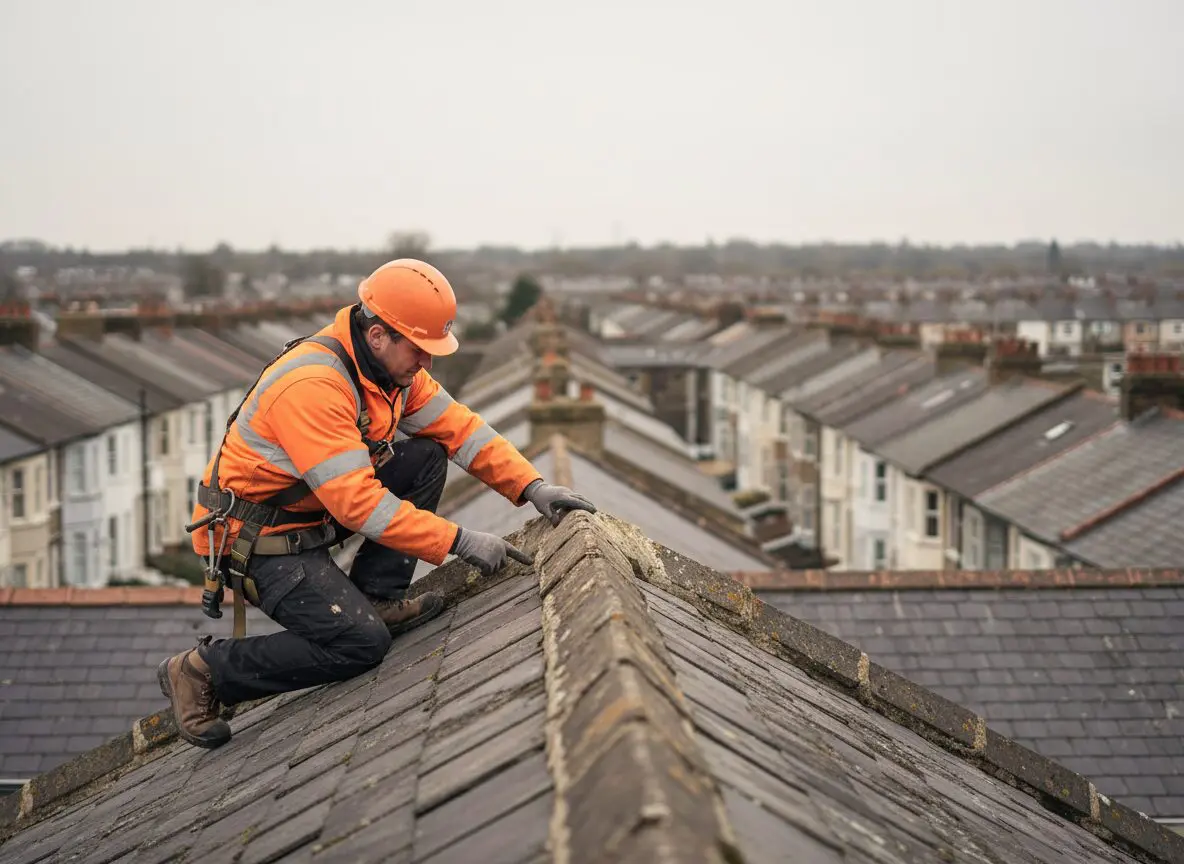
Why Sheffield roofs sag in the first place
Age is a factor, but it is not usually the cause on its own. In our experience across Sheffield, Rotherham and Barnsley, four things do most of the damage.
Water, arriving somewhere it should not. A failed valley, a slipped tile or a chimney flashing that has let go will wet the same square metre of timber for years. Rot in a purlin end where it sits into the gable wall is one of the most common findings we make.
Overloading. A roof that has been re-covered with something heavier than it was designed for will settle. This matters enough that building control cares about it: approval is required where a new covering increases the weight of the roof covering by 15 per cent or more. Concrete tiles laid over a structure sized for thin natural slate is the version we see most.
Struts that were cut, moved or never replaced. Loft boarding, water tank relocations and DIY conversions all tend to involve someone deciding a diagonal timber is in the way.
Undersized timber from the outset. Some pre-war roofs were built with purlins that were marginal when new and are simply at the end of their working life.
Our view: a sag that has been the same shape for twenty years and shows no cracking, no damp and no movement in the ceiling below is usually not an emergency. A sag that has changed in the last two winters is. Most guides tell you every sag is urgent — that is not our experience, and it pushes people into work they do not need. What matters is whether it is moving.
What sagging roof repair costs in Sheffield
These are indicative ranges from jobs we have priced across South Yorkshire. Every roof is different, so treat them as a guide to the order of magnitude rather than a quotation.
| Work | Typical range | What drives it |
|---|---|---|
| Re-bedding a settled ridge line | from £450 | Length of ridge, access, whether dry ridge is fitted |
| Replacing rotten rafter feet at the wall plate | from £600 | Number of rafters, stripping needed to reach them |
| Sistering a deflected purlin (bolting new timber alongside) | from £1,200 | Span, loft access, whether ceilings must come down |
| Full purlin replacement with props and steels | £1,800 – £4,500 | Span, engineer involvement, scaffold, building control |
| Re-strutting and re-tying a spread roof | £2,500 – £6,000 | Extent of spread, wall repairs, structural design |
| Structural repair carried out during a full re-roof | add 10–20% to the re-roof | Scaffold and strip-off are already paid for |
Prices are from-figures based on our own recent Sheffield work and are not a quote. We inspect before we price.
The single biggest saving available on this kind of job is timing. If the roof is coming off anyway, the scaffold, the strip and the access are already in the price, and the timber repair is marginal cost. That is why we always ask how old the covering is before quoting a structural repair in isolation. If you are near that decision, our rundown of the signs a roof has reached the end of its life is a useful sense-check, and the full re-roofing guide sets out what the bigger job involves.

When building control has to be involved
This is the part that catches people out, because it does not follow the same logic as planning permission.
For ordinary repair or re-covering work, you will not normally need a building control application if less than 25 per cent of the total building envelope and less than 50 per cent of the roof is affected. But the same guidance is explicit that you do need approval if you carry out structural alterations.
Replacing or resizing a purlin is a structural alteration. So is removing or repositioning struts, or altering the way the roof is tied. A competent roofer will tell you this at quotation stage and factor the notification in; if nobody mentions building control on a purlin job, ask why.
It is worth knowing the reason, too. The same guidance warns that removing or altering roof elements can cause movement, which in turn can crack the walls and, in the worst case, lead to collapse. The approval process exists because the load has to go somewhere, and a repair that ignores that simply relocates the problem.
We will get into the loft, look at the timber itself and tell you honestly whether it is moving. Call 07852 940350 or email ajrroofing17@gmail.com.
What we actually do on the first visit
A sagging roof cannot be diagnosed from the outside. Anyone who quotes for one without going into the loft is guessing.
We start inside. We look at the purlin along its length for deflection and for dark staining at the ends where it beds into the wall. We check the struts are still where they should be and still bearing on something solid. We probe suspect timber — sound timber resists a screwdriver, rotten timber does not. We look at the ceiling joists and any collar ties for signs the roof has spread.
Then we go outside and look at the covering, the valleys, the flashings and the gutter line, because the water that caused the rot is almost always still getting in. Fixing the timber and leaving the leak is the most common way this job gets done badly. If you want to know what a proper inspection covers, we set it out in our guide to what a Sheffield roof inspection includes.
Where the deflection is significant or the span is long, we will say so and involve a structural engineer. That costs money and we would rather tell you at the start than halfway through.
Frequently Asked Questions
Is a sagging roof dangerous?
Not automatically. A long-standing, stable sag on an older Sheffield roof is very common and often causes no immediate risk. What changes the answer is movement: a sag that is deepening, new cracks in the walls or ceilings, doors that have started to bind upstairs, or daylight visible at the ridge. Any of those warrants an inspection quickly.
Can a sagging roof be repaired without replacing the whole roof?
Usually, yes. Sistering a new timber alongside a deflected purlin, replacing rotten rafter feet, or re-strutting are all targeted repairs that leave the covering largely intact. Full replacement becomes the sensible route when the covering is also at the end of its life, because you would be paying twice for the same scaffold.
How much does it cost to fix a sagging roof in Sheffield?
As a broad guide, from around £450 for a settled ridge, from £1,200 to sister a purlin, and £1,800 to £4,500 for a full purlin replacement with propping. Cost is driven mainly by span, access and whether ceilings have to come down. These are from-prices, not quotations.
Do I need building regulations approval to replace a purlin?
Yes. Replacing or resizing a purlin is a structural alteration, and structural alterations require building control approval regardless of how little of the roof area is affected. Straightforward repair or re-covering below the 25 per cent envelope and 50 per cent roof thresholds does not.
Will my insurance cover a sagging roof?
Generally only where the damage is sudden and caused by an insured event, such as a storm or an impact. Gradual deterioration, rot and wear and tear are normally excluded. If a storm has caused or worsened it, photograph it and report it before any work starts.
How long does a purlin repair take?
A sistered purlin is often a one to two day job once access is set up. A full replacement with propping and building control involvement typically runs three to five days, plus scaffold time either side. Weather matters less than usual because most of the work is inside.
Call AJR Roofing on 07852 940350 for a free, no-obligation quote. We inspect before we price — no surprises.
Reviewed and signed off by AJR Roofing— working roofers covering Sheffield, Rotherham, Barnsley, Doncaster, Chesterfield and the surrounding area. Prices are indicative from-figures based on our own recent work and are not a quotation. Structural roof repair should always be specified by a competent person.
Published 29 October 2026 · Last updated 29 October 2026