
How to Maintain a Flat Roof: Annual Checks, Common Problems and When to Call a Roofer
- Why flat roofs need regular maintenance
- Annual flat roof inspection checklist
- Common flat roof problems to watch for
- Maintaining EPDM rubber roofs
- Maintaining GRP fibreglass roofs
- Maintaining felt flat roofs
- When to DIY and when to call a roofer
- How often should a flat roof be professionally inspected?
Why Flat Roofs Need Regular Maintenance
Flat roofs are designed to be durable, but they face a different set of challenges compared to pitched roofs. Water doesn’t drain away by gravity alone — it has to move to outlets or edges, and if anything obstructs that path, it pools.
In Sheffield’s climate, flat roofs are exposed to freeze-thaw cycles through winter, UV degradation through summer, and debris accumulation year-round. Each of these puts stress on the roof membrane, particularly at joints, edges, and penetrations like pipes or skylights.
The good news is that most flat roof failures don’t happen suddenly. They develop gradually, from small cracks or gaps that allow moisture into the structure below. A regular inspection programme means you find these early — when a sealant or patch repair might cost £100–£200 rather than a full roof replacement at £1,500–£4,000.

Annual Flat Roof Inspection Checklist
You don’t need to walk on the roof to carry out most of this checklist. Many checks can be done from ground level, from a loft hatch, or carefully from a ladder at the roof edge.
From outside:
- Check drainage outlets and gutters are clear of leaves, moss, and debris
- Look for standing water or obvious dips in the membrane surface
- Check the roof edge — look for any membrane that has lifted, pulled back, or lost its seal against the parapet or fascia
- Check around any penetrations (pipes, Velux windows, vents) for signs of cracking or lifting sealant
- Look for blistering or bubbling in the membrane surface — this suggests moisture trapped beneath
- Check the condition of the upstand where the membrane meets a wall or parapet — this is a common failure point
From inside the building:
- Look for any water staining on ceilings beneath the flat roof area
- Check for damp smells or mould growth in rooms directly below
- If there’s a loft hatch or access above the flat roof area, check timbers for signs of moisture
Common Flat Roof Problems to Watch For
Understanding what you’re looking for makes your inspection more effective. These are the problems that come up most often on Sheffield flat roofs:
Ponding water: If water sits on the roof surface for more than 48 hours after rain, the drainage isn’t working properly. This might be a blocked outlet, or the roof may have developed a low spot through subsidence or deck movement. Ponding accelerates deterioration in all roof types.
Edge lifting: The membrane at the perimeter is under constant tension. In cold weather it contracts; in summer it expands. Over time, this movement can cause the membrane to pull away from the edge trim, fascia, or parapet. Once the edge seal is broken, wind-driven rain gets in.
Blistering: Bubbles or blisters in a felt or EPDM surface usually indicate that moisture became trapped during installation or entered through a small defect and has been heated to steam by the sun. Small blisters may be stable; large or multiple blisters indicate a problem that needs attention.
Cracking around penetrations: Pipes, extraction fans, Velux windows, and any other element that passes through the roof membrane are potential weak points. The sealant or flashing around these should be checked every year.
Moss and algae growth: Moss holds moisture against the roof surface and can gradually work its way under the membrane. It also blocks outlets. Remove it carefully — chemical treatments are available that won’t damage the membrane.
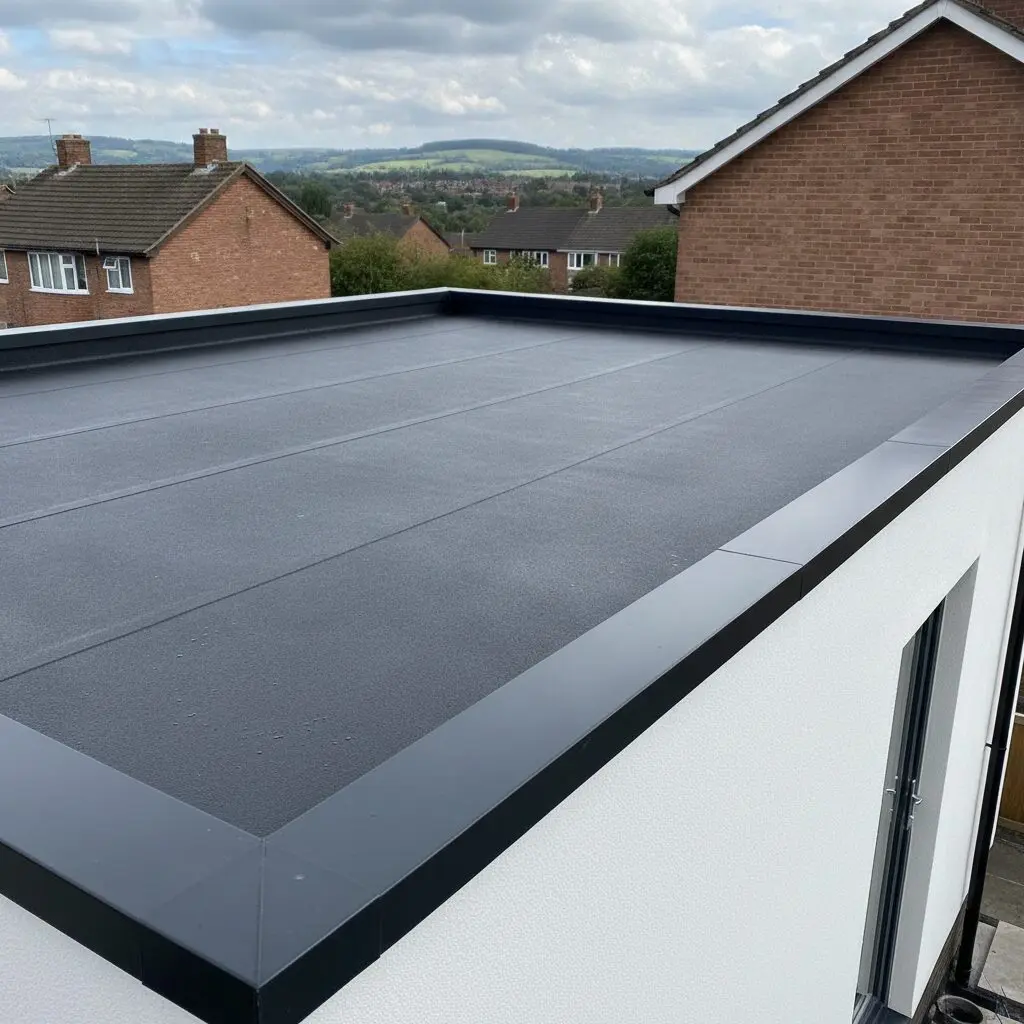
Maintaining EPDM Rubber Roofs
EPDM (ethylene propylene diene monomer) rubber roofs are increasingly common on Sheffield house extensions and outbuildings. When properly installed, they’re low-maintenance and very durable.
Key maintenance tasks for EPDM:
- Clean the surface annually using a soft brush and mild detergent — avoid solvents or petroleum-based cleaners, which degrade the rubber
- Check all seams and overlaps — EPDM is typically bonded at seams with specialist adhesive, and these are the most likely points of failure
- Inspect the drip edge trim around the perimeter and ensure it’s securely fixed
- Check where the EPDM meets any upstands or abutments — the membrane should be fully bonded up the wall face
EPDM roofs don’t need sealant or coating — the membrane itself is the waterproofing layer. If you see cracking or a tear, that’s a job for a roofer, not DIY patching with general-purpose tape.
Maintaining GRP Fibreglass Roofs
GRP (glass-reinforced polyester) flat roofs are extremely tough and have a hard, smooth surface that resists moss well. They’re the most durable of the common flat roof types when correctly installed.
Maintenance for GRP is straightforward:
- Clean the surface once a year with a non-abrasive cleaner — the gelcoat surface can scratch
- Check the edge trim (usually an aluminium or GRP trim) for signs of separation from the deck
- Look at upstands for any cracks in the gelcoat — these are usually cosmetic but can let in moisture if deep
- Every 10–15 years, a new topcoat (gelcoat) may be applied to restore the surface and reseal minor crazing
GRP roofs rarely fail outright. Most problems involve the edge trim, expansion cracks, or issues at penetrations. A good-quality GRP roof should last 30–40 years with basic care.
Maintaining Felt Flat Roofs
Traditional torch-on felt roofs have a shorter lifespan than EPDM or GRP — typically 15–25 years — and need more regular attention. If your property has an older felt roof, it’s worth being more proactive with maintenance.
For felt roofs:
- Check the surface for cracking, splitting, or areas where the top layer has worn thin
- Look for lap joints that may have opened — these are visible as lines across the surface where the felt sheets overlap
- Clear drainage outlets regularly, as felt roofs are more prone to moss build-up
- If the felt is original and more than 15 years old, have it inspected by a roofer who can assess whether it still has serviceable life
Unlike EPDM or GRP, felt can sometimes be patched at localised failure points. However, if the felt is generally deteriorated across the whole surface, a patch won’t be a lasting fix — replacement is the right call.
When to DIY and When to Call a Roofer
Safe to do yourself: Clearing debris from outlets, gentle moss removal from the surface, basic cleaning, and visual inspections from ground level or a safe access point.
Call a roofer for: Any repair that involves cutting, bonding, or sealing the membrane itself, anything involving working above ground level without proper scaffold, any situation where you’re not sure what you’re looking at, signs of water ingress from below, blistering or lifting across a significant area, and anything around penetrations or upstands.
Flat roof repairs done incorrectly can make things worse — particularly if the wrong sealants are used on EPDM or the surface is damaged by heavy foot traffic without proper boards. A competent roofer will diagnose the cause, not just cover the symptom.
How Often Should a Flat Roof Be Professionally Inspected?
For most flat roofs, a professional inspection every three to five years is sensible — in addition to your own annual visual checks. A roofer can access the surface safely, check areas you can’t reach from the edge, and assess the condition of all the components that aren’t visible from below.
If your flat roof is older or has had previous repairs, more frequent inspections are worthwhile. The cost of an inspection is a small fraction of what water damage to a ceiling, wall, or floor can end up costing.
AJR Roofing carries out flat roof inspections, maintenance work, and full replacements across Sheffield and South Yorkshire. If you haven’t had your flat roof looked at for several years, it’s worth doing before the autumn.
Get a free quote
Call 07852 940350 or email ajrroofing17@gmail.com. Tell us what you can see, and if you can, send a photo — it helps us advise the right next step.